26.05.26
How Cost-to-Complete Funding Works
We are often asked about mezzanine finance when dealing with developers. Today we wanted to put a blog together that defines what mezzanine finance is and where it is appropriate to use.
Here's how it works.
The Basic Concept
Cost-to-complete funding means the lender's facility is structured to cover 100% of the project's remaining expenses at all times. The lender evaluates the project budget thoroughly, monitors expenses throughout the build, and disburses funds in alignment with the project's progress.
It's not a lump sum. It's not a line of credit you draw at will. It's a structured commitment where every drawdown is tied to certified costs, and the remaining facility always matches what's left to spend.
At NZMS, we assess four things before structuring a CTC facility: the status of consents, the project budget and feasibility, values "as if complete" and any presales, and the capabilities of the contractor and development team.
What We Need Upfront
Before we arrange a development facility, we require a detailed development budget covering all costs — land acquisition, soft costs (planning, consents, professional fees), hard costs (civil works and construction), and other expenses like utility connection fees, development levies, and a contingency reserve. We also review any presales, valuations, construction contracts, and consents.
In most cases, an independent Quantity Surveyor — selected by the developer, not by us — reviews this information and prepares a Pre-Condition Report for the lender. This becomes the baseline budget that everything is measured against.
The Equity-First Principle
This is the core mechanic, and it's the part that catches people off guard if they haven't been through it before.
The developer's equity goes in first. It fills the gap between the loan facility and the total project cost, ensuring our facility covers 100% of the project's remaining expenses from that point forward.
A simple example: if total project costs are $10M and the loan facility is $8M, the developer is required to spend the first $2M. That equity covers the land, early soft costs, and preliminary expenses that get the project to the point where construction costs can be clearly defined.
Before the facility activates, all consents need to be granted, contracts need to be in place, and any conditions precedent (such as presales) need to be met. Once those boxes are ticked and the equity requirement is fulfilled, NZMS funds the remainder.
How Drawdowns Actually Work
Let's walk through a real scenario.
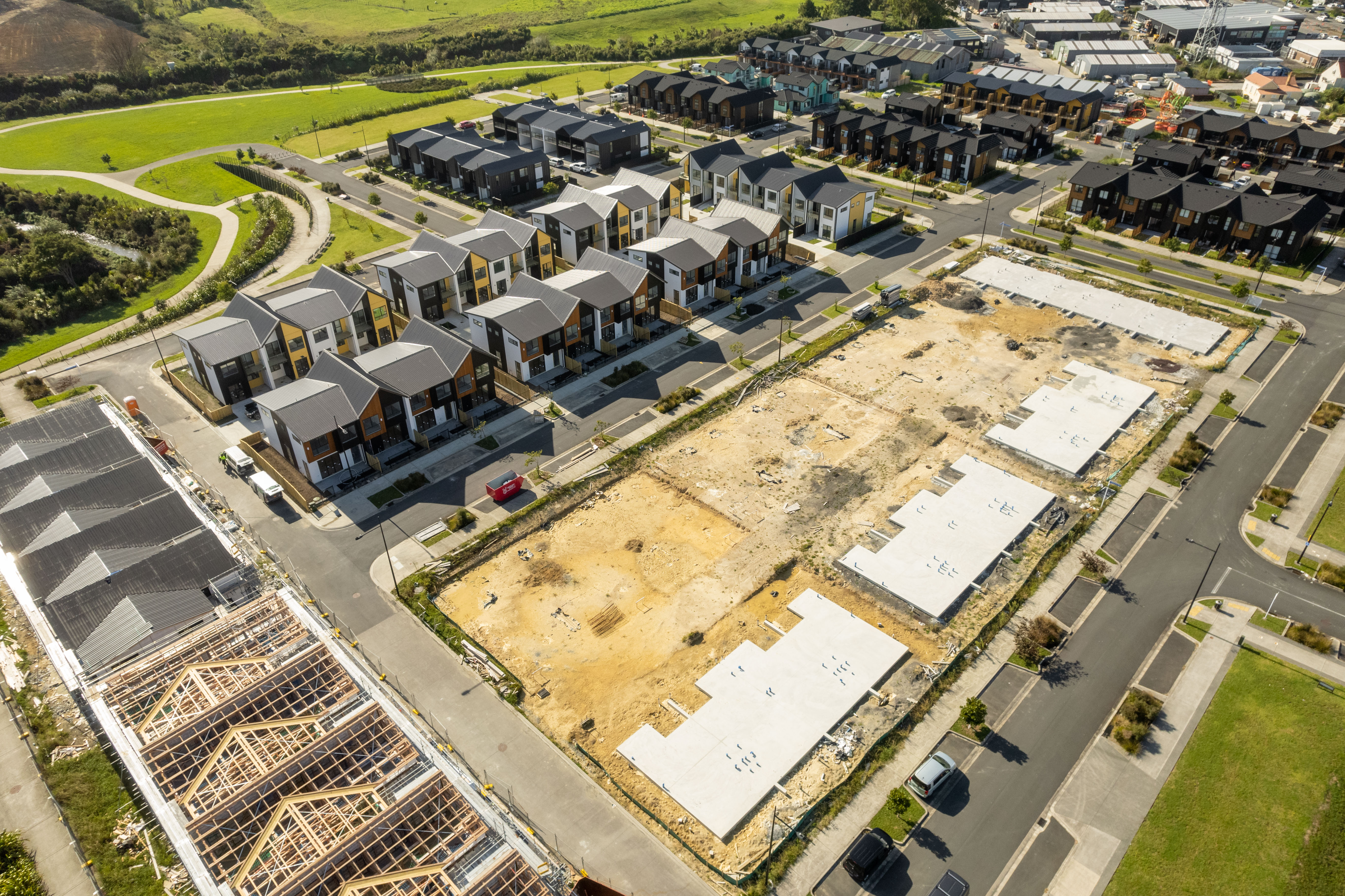
A developer is building townhouses with a total development cost of $5,709,597. NZMS has approved a facility of $4,883,000 (85% of cost, excluding interest and fees). The developer's equity requirement is $826,597.
First drawdown. By this point, the developer has already incurred $1,372,481 in costs to date — land, early consultants, some civils, marketing setup. The QS certifies $479,018 of work for the current month. The cost to complete the project is assessed at $3,858,098 (total project cost less all expenditure to date).
Note that $26,166 of the contingency budget has already been used for unforeseen costs this month — that shows up transparently in the QS report.
The drawdown calculation works like this: the NZMS facility is $4,883,000. Subtract $910,000 already utilised at settlement to refinance an existing mortgage, leaving $3,973,000 available. Subtract the cost to complete ($3,858,098), and the developer can draw $114,902. They've now invested their full equity requirement of $826,597.
Second drawdown, one month later. The QS certifies $285,364 of completed works. The cost to complete drops to $3,572,734. The NZMS facility allows a drawdown of $285,364 — sufficient to cover the month's expenditure in full. The developer isn't contributing any additional equity. We're funding the build.
This pattern repeats monthly until the project reaches practical completion.
The Role of the Quantity Surveyor
The QS is central to the whole process. Every month, they certify the completed works and calculate the amount available to draw down, line by line — consultants, council, civils, construction, contingency. They update the cost-to-complete figure each month against the original budget.
This gives everyone clarity. The developer knows exactly what they can draw and when. The lender knows exactly where the project sits against budget. And if something has gone sideways — a cost blowout, a variation, contingency being eaten into — it surfaces immediately rather than three months down the track.
Two Drawdown Structures
We offer two approaches depending on the project's complexity:
Monthly certified drawdowns provide continuous cash flow and flexibility. The QS certifies completed works each month, the cost to complete is updated, and funds are released accordingly. Most developers and contractors prefer this — it keeps cash flowing on time and gives a clear monthly picture of where the project stands.
Progress or milestone payments are tied to specific project stages rather than monthly certifications. This can simplify financial planning and reduce administration, but it's less flexible — if unforeseen delays push a milestone out, there can be cash flow gaps in between.
NZMS considers the project's complexity when recommending one structure over the other.
How Contingency Works
Every development budget includes a contingency line. It's a financial buffer for the unforeseen costs that inevitably come up — construction delays, cost inflation, unexpected site conditions.
Here's what happens in practice. If cost overruns or significant variations exhaust the contingency, the developer may be required to inject additional equity or seek a facility increase to bring the CTC budget back into alignment with the remaining facility.
But the reverse is also true. If cost savings arise during the project — the build comes in under contract, a consultant's scope reduces, site conditions turn out better than expected — those savings can be released back to the developer by NZMS. You're not penalised for good project management.
How We Handle GST
This is one of those practical details that matters more than people expect.
NZMS pays the GST component of invoices on top of the available drawdown amount. The developer then returns the GST refund to NZMS when it comes back from IRD, and it's credited to the loan balance.
No separate GST facility is required. No complicated parallel structure.
Using the month-two example: the certified drawdown is $285,364, plus GST of $42,805, giving a total payment to the developer of $328,169. When the GST refund comes through, it goes straight back to NZMS.
Releasing Equity Back to the Developer
This is the part of CTC funding that most people don't know about.
When the loan facility provided by NZMS exceeds the estimated costs to finish the project, the surplus allows the developer to draw back some — or all — of their initially invested equity.
The sequence works like this:
Initial equity investment. The developer uses their equity early in the project lifecycle, acquiring the land and funding the preliminary expenses that get the project to the point where construction can commence.
CTC activation. The project reaches the point where all consents are in place, conditions precedent are met, and remaining costs can be clearly articulated. The NZMS facility kicks in and covers future expenses.
Loan facility surplus. When the total facility arranged with NZMS surpasses the calculated cost to complete the project, this surplus allows the developer to draw back their invested equity. This might happen from the very first drawdown if arranged in advance, or it may emerge as the loan progresses and development costs are saved.
This is a standard feature of how CTC facilities work at NZMS — not a special arrangement.
The Funding Spectrum
It's worth understanding where CTC funding sits relative to other options in the New Zealand market.
Banks typically fund 60–70% of total project costs. Finance companies generally sit at 70–85%. NZMS funds 85–100%+ of project costs, with the ability to structure equity release through the CTC model.
The higher up that spectrum you go, the less equity a developer needs to lock up in any single project — which has obvious implications for how many projects you can run concurrently.
What Makes a Good CTC Candidate
Not every project or developer is suited to CTC funding. Here's what we look for:
A credible developer. Track record matters. We back people who've demonstrated they can deliver projects on time and on budget.
A solid budget. The development feasibility needs to work. Total project cost, build contract, QS cost plan, contingency — the numbers need to stand up to scrutiny.
A clear exit. How are the units going to sell or refinance? We don't necessarily require pre-sales, but we do need a credible exit strategy — whether that's sell-down on completion, refinance to a long-term facility, or a combination.
Appropriate security. We take a first mortgage over the development property. The LVR needs to work — typically up to 85% of total project cost.
The Bottom Line
Cost-to-complete funding is a structured, transparent model. Your equity goes in first. The lender's facility covers the remaining costs. Drawdowns are certified monthly by an independent QS. Contingency is monitored in real time. And if the numbers work in your favour, your equity can come back to you before the project even completes.
It's not complicated, but it is precise — and understanding the mechanics puts you in a much stronger position when you're structuring your next development facility.
NZMS is a non-bank development finance lender with over 40 years of industry experience, backed by Mansons TCLM. Over $5 billion in projects funded, $450M available.
Questions about CTC funding? Get in touch at nzms.co.nz or email [email protected]
Next article

28.04.26
From 10 Houses to 100+: Why Funding Structure Is the Real Bottleneck
Read now →